

Recent forward movement in the Visa Bulletin for India EB-2 and EB-3 categories, particularly in April 2026, has prompted renewed optimism among stakeholders. However, when viewed in the context of February and March 2026 activity, the data suggests that this movement may be episodic and potentially artificial, rather than a sign of sustained progress.
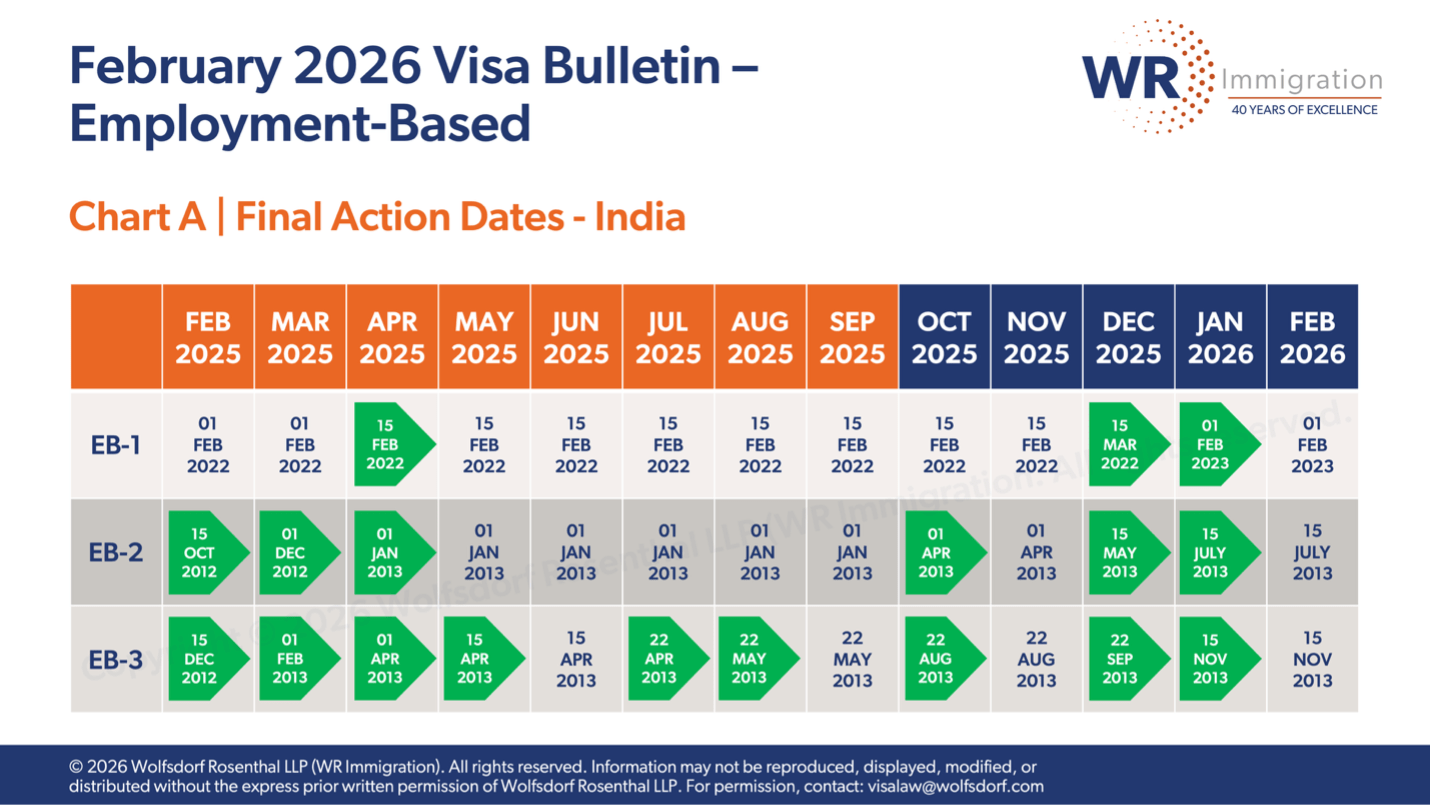
1. February 2026: No Movement
The February Visa Bulletin showed no advancement in the India EB-2 and EB-3 Final Action Dates, underscoring the continued severity of backlogs:
• EB-2: No movement (remained at July 15, 2013)
• EB-3: No movement (remained at November 15, 2013)
This established a clear baseline, with demand remaining high and visa availability constrained.
2. March 2026: Uneven and Selective Advancement
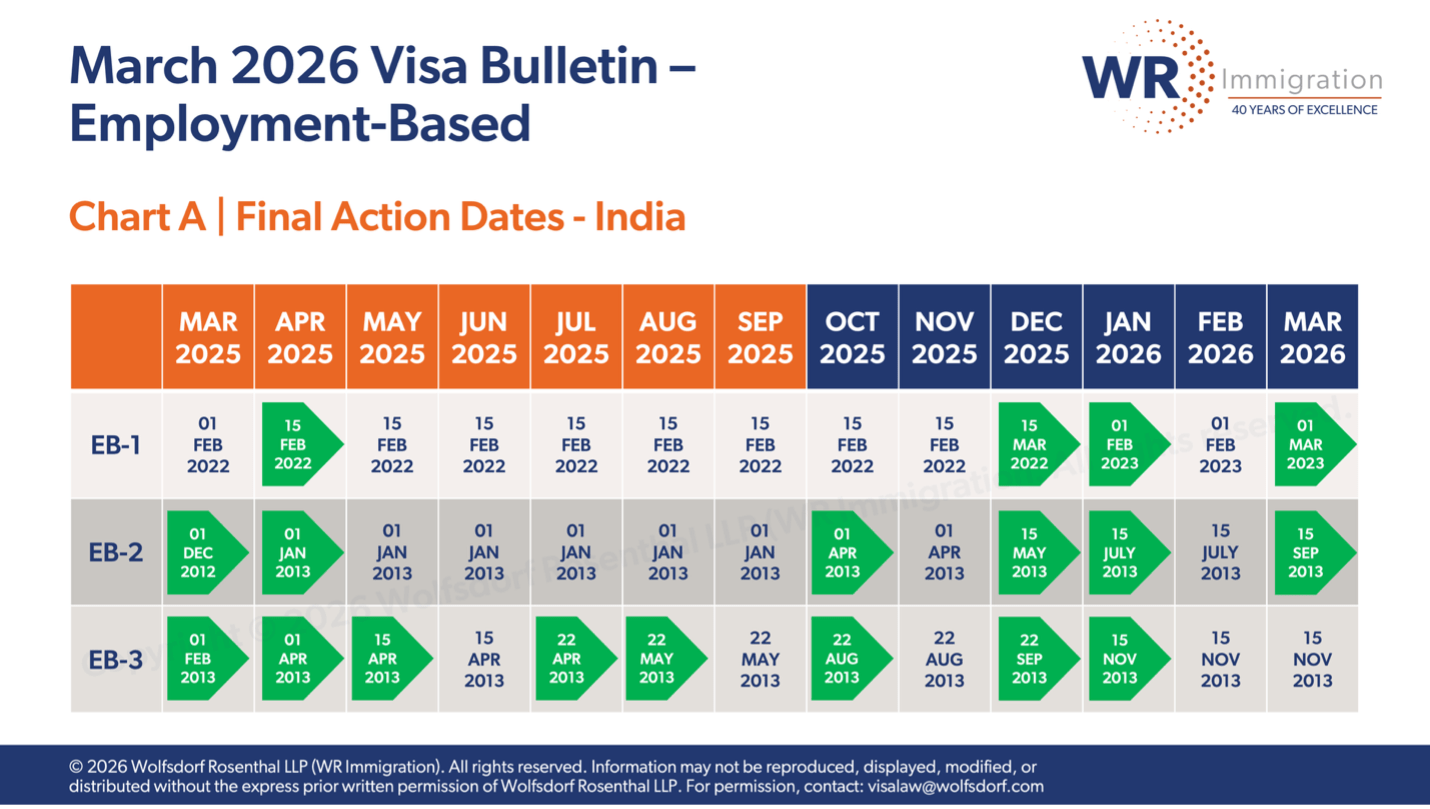
The March Visa Bulletin for India introduced targeted forward movement, but only in certain areas:
Final Action Dates (used for adjustment of status filing):
• EB-2: Advanced from July 15, 2013 to September 15, 2013 (approx. +2 months)
• EB-3: No movement (remained at November 15, 2013)
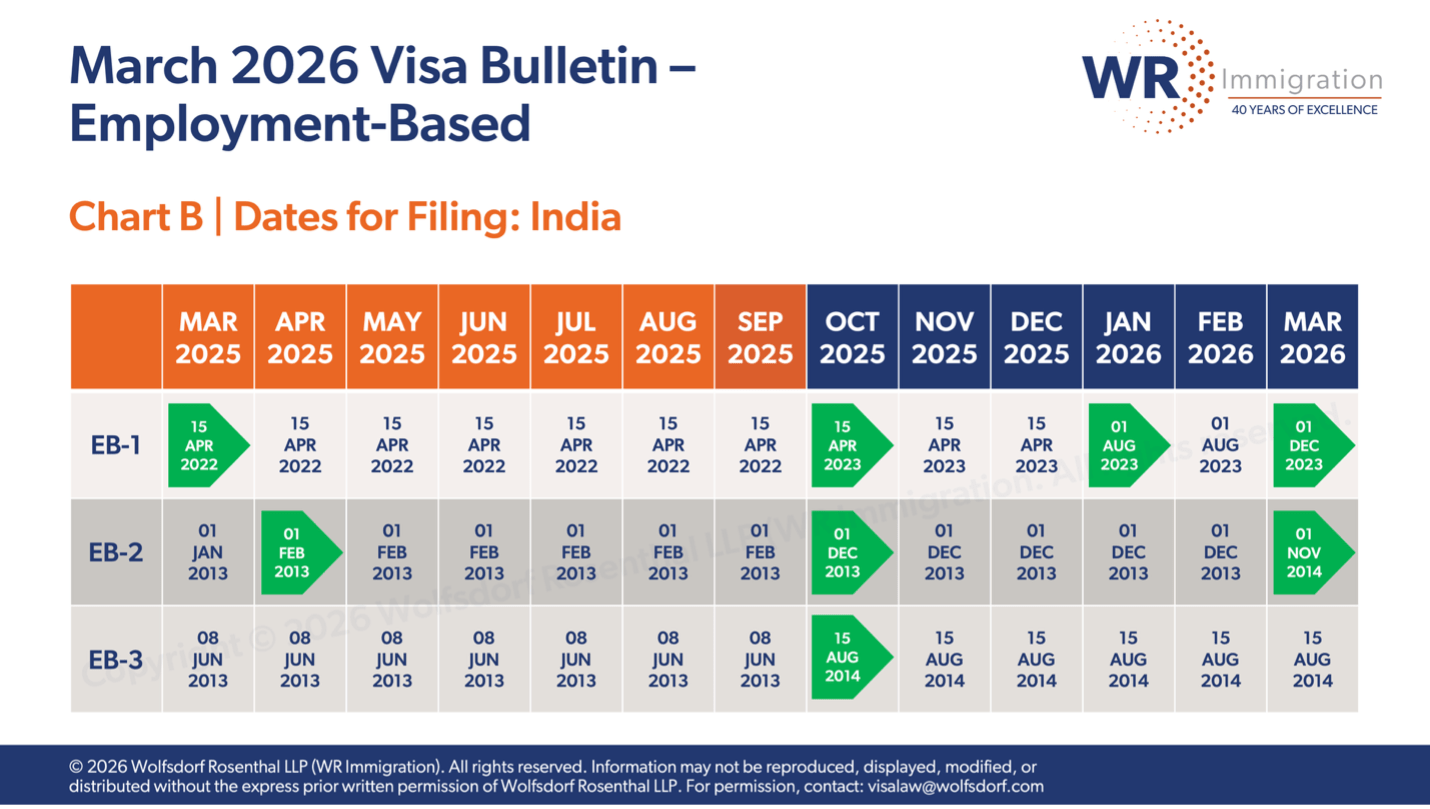
Dates for Filing (less restrictive chart):
• EB-2: Advanced significantly from December 1, 2013 to November 1, 2014 (approx. +11 months)
• EB-3: EB-3: No movement (remained at August 15, 2014)
Key takeaway:
• Movement was concentrated in EB-2 (especially filing dates)
• EB-3 remained static
• The divergence between charts suggested administrative recalibration rather than demand-driven change
3. April 2026: Sudden Forward Movement for India Dates for Filing:
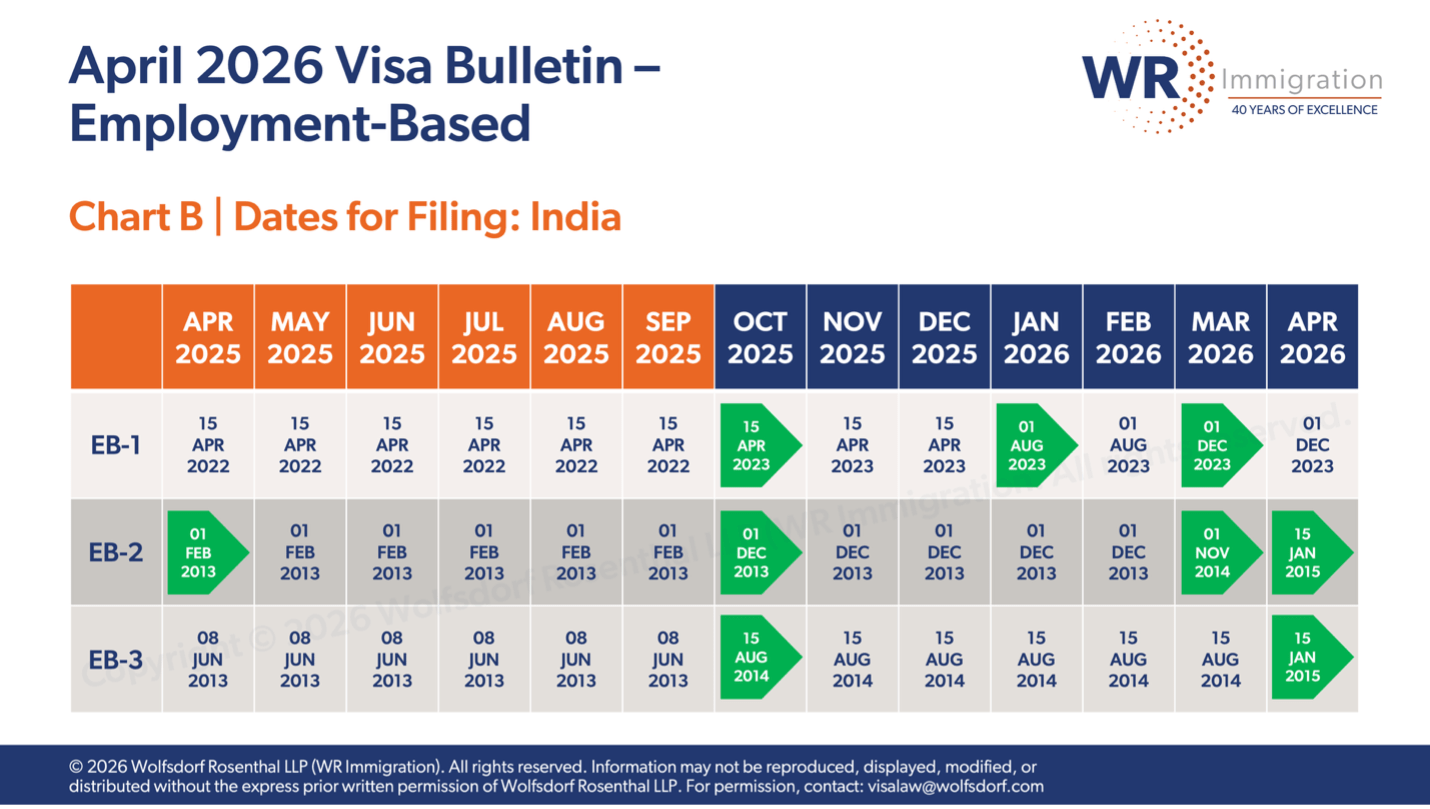
The April Visa Bulletin shows more noticeable advancement, particularly in Dates for Filing for India:
• EB-2: Advanced from November 1, 2014 to January 15, 2015 (approx. +2.5 months)
• EB-3: Advanced from August 15, 2014 to January 15, 2015 (approx. +5 months) This builds on the already significant jump in March 2026, creating the appearance of accelerating progress.
4. Why This Movement May Be “Artificial”
Despite the apparent forward momentum, discussions with former DOS official Charles Oppenheim and industry stakeholders emphasize that:
• These movements are likely driven by visa number allocation strategy, not reduced demand
• The government is advancing dates to stimulate filings and gauge demand
• Such advancement can be quickly reversed (retrogression) if excessive demand materializes
The pattern supports this view:
• February 2026: Stagnation
• March 2026: Selective and uneven movement
• April 2026: Additional, but still limited, forward movement
This is not a steady trend, but rather a series of adjustments.
5. Practical Implications for Employers and Beneficiaries
Short-term opportunities:
• Some beneficiaries may now be eligible to file adjustment applications (depending on USCIS chart usage)
• Employers should act quickly where eligibility arises
Long-term caution:
• Do not assume continued forward movement to be the norm
• Prepare for possible retrogression at some future time
• Avoid making workforce or retention decisions based solely on recent advancement
Conclusion
While the April 2026 Visa Bulletin shows continued forward movement for India EB-2 and EB-3, following a notable shift in March 2026, this progression should be viewed cautiously.
The following observations are based on statements from former DOS official Charlie Oppenheim:
“I believe that the movements are artificial and only based on the Administration’s policy on visa processing for the 75 countries. How long that policy will be applied is anyone’s guess, and once it ends there has to be the boomerang effect.
India EB-2 Final Action Date movement in FY 2026:
• October 2025: 01APR13
• November 2025: 01APR13
• December 2025: 15MAY13
• January 2026: 15JUL13
• February 2026: 15JUL13
• March 2026: 15SEP13
• April 2026: 15JUL14These are completely artificial movements, and if or when the Administration’s restrictions affecting the 75 countries are lifted, there will be a boomerang effect. Unfortunately, with this Administration there is no telling when that change may occur.
The longer the policy remains in place, the more severe the corrective action may be. The affected applicants are not going away and will be at the front of the visa line with early Rest of World priority dates. This would mean that China and India would again be subject to their low per-country limits, which have constrained date movement over the past several years.
This is similar to what occurred during the COVID period, when employment-based annual limits were temporarily increased, reaching 281,000 in FY 2022. At that time, many did not anticipate the need for later corrective action, including retrogression and slowed movement. The pattern was similar to a period of rapid expansion followed by contraction.
The current situation involving the 75-country policy has reduced Rest of World demand in certain countries, resulting in otherwise unused numbers being made available to countries such as India.”
For more information on the Visa Bulletin, tune in every month to Chatting with Charlie with Charlie Oppenheim and WR Immigration Partner, Charina Garcia.

Subscribe to the WR Immigration Newsletters

Start the RFP Process

Join the Corporate Benchmarking Roundtable